

Blog


- Key facts at a glance
- Define the peptides before comparing them
- Local repair signaling vs actin-linked migration
- When researchers discuss one peptide, the other, or both
- BPC-157 vs TB-500: side-by-side research-use review
For laboratory research and development purposes. Not for human consumption. Not approved for therapeutic use. This guide is educational research-use content and must not be interpreted as medical, dosing, injury-treatment, or recovery advice.

- How BPC-157 and TB-500 differ by research pathway, not by online hype
- Why BPC-157 is discussed around local repair, angiogenesis, and gut-origin signaling
- Why TB-500 is discussed around thymosin beta-4 fragment biology and actin-linked migration
- When published research discusses one peptide, the other, or a combined stack — and what that does not prove
- The preclinical evidence limits that constrain any comparison
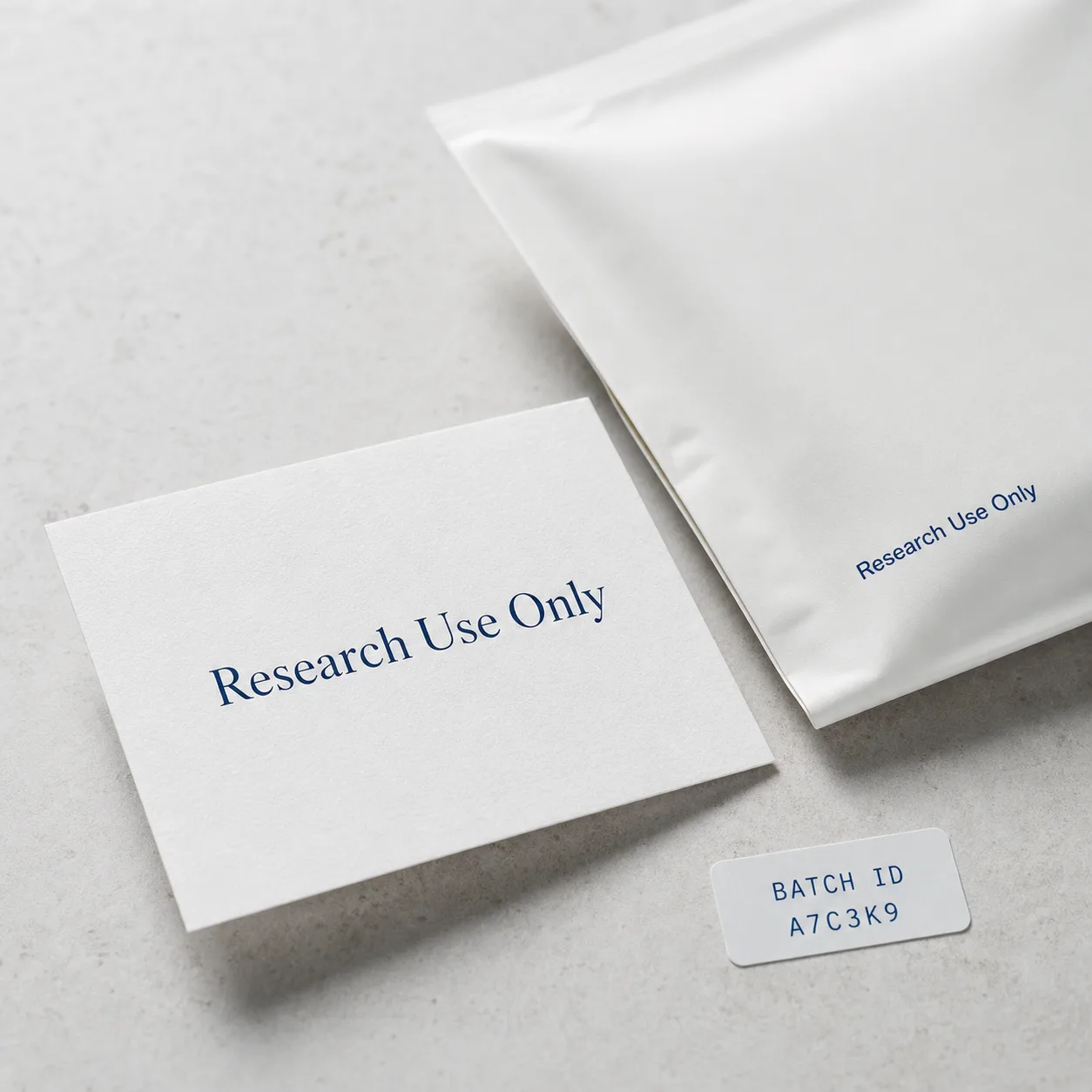
- COA, purity, batch identity, and UAE storage checks before any research purchase
BPC-157 and TB-500 are two of the most searched research peptides in tissue-repair discussion — and two of the most often confused. They are not interchangeable labels for the same mechanism. BPC-157 is a 15-amino-acid pentadecapeptide originally isolated from human gastric juice and discussed in preclinical literature around local repair signaling, angiogenesis, and gut-related protective pathways. TB-500 is a synthetic peptide fragment derived from thymosin beta-4 and discussed in research around actin dynamics, cell migration, and matrix remodeling. In a UAE research-use context, the useful comparison is therefore about pathway, evidence maturity, stacking logic in the literature, and what you can verify on a supplier shelf — not about which compound “heals faster” or which one a person should use after an injury.
This article does not compare injury outcomes, recovery timelines, dosing, side effects, treatment suitability, personal use, or which compound is better for a person. Neither BPC-157 nor TB-500 is approved as a therapeutic medicine for tissue repair in the research literature reviewed here.

01 · Terminology
Define the peptides before comparing them
Two repair-adjacent names, two different molecular stories.
BPC-157 (Body Protection Compound-157) is a synthetic pentadecapeptide whose sequence corresponds to a fragment found in human gastric juice. In published preclinical work it is studied as a stable, water-soluble peptide with interest in wound-healing models, tendon and ligament research, angiogenesis assays, and gastrointestinal protective signaling. It is not an approved medicine, and supplier listings should be read as research-use material — not as a branded therapeutic product. For deeper pathway context, see the dedicated BPC-157 research overview and the BPC-157 product page for batch and documentation signals.
TB-500 is the common research shorthand for a synthetic peptide fragment of thymosin beta-4 (Tβ4) — a 43-amino-acid protein involved in actin sequestration and cell motility. The fragment sold in research contexts is not the full protein; it is a shorter sequence (often discussed as the active region of Tβ4) studied in models of cell migration, wound closure, and matrix interaction. Thymosin beta-4 itself has appeared in formal medicine development pathways for different indications, but TB-500 as a research peptide fragment is a separate supply category with its own documentation requirements. See the TB-500 tissue repair research guide and TB-500 product page for pathway and verification context.
Naming traps. Online discussion often collapses “repair peptide,” “recovery peptide,” and “healing stack” into one bucket. That collapse hides real mechanistic differences. BPC-157’s gastric origin and local angiogenesis framing are not the same research story as TB-500’s actin-and-migration framing — and neither story, on its own, verifies the quality of a specific vial from a UAE supplier.

02 · Mechanism
Local repair signaling vs actin-linked migration
Latest research insights. No spam, ever.
Mechanism is orientation for research design — not a buying promise.
Published preclinical work on BPC-157 often clusters around a few recurring themes: promotion of angiogenesis in wound and ischemia models, effects on tendon and ligament fibroblast behavior, modulation of growth-factor signaling (including VEGF-linked pathways in some studies), and gastrointestinal protective effects in rodent models of ulceration and inflammatory injury. Researchers describe it as acting at or near injury sites in animal models — a “local repair” framing that distinguishes it from systemic hormones. The gut-origin narrative matters because BPC-157’s discovery context is gastric, and much of the early literature connects it to mucosal protection and nitric oxide–linked pathways. None of this establishes human therapeutic efficacy or translates directly to research-use product quality.
Published work on TB-500 centers on a different axis: thymosin beta-4’s role in regulating actin polymerization. Tβ4 binds G-actin and influences filament dynamics; the TB-500 fragment is discussed in research as retaining motility-relevant activity — supporting cell migration, wound-edge closure, and matrix remodeling in vitro and in animal models. Where BPC-157 is often framed as local signaling and angiogenesis, TB-500 is often framed as enabling cell movement into a repair zone. Again, mechanism language explains the type of research question — it does not prove that a supplier batch will behave as described in a paper, and it does not support human injury treatment claims.
GJsrc
Gastric origin
BPC-157’s literature ties to gastric juice isolation and gut-barrier protective models — a different starting point from thymosin biology.
ANGio
Angiogenesis
BPC-157 preclinical studies often report vascular and growth-factor-linked endpoints in wound and tendon models.
ACTin
Actin dynamics
TB-500 is discussed through thymosin beta-4’s actin-sequestration role and cell-migration assays.
COAled
Quality signals
Mechanism papers do not replace COA, batch identity, or HPLC context on the product you actually receive.

03 · Stack vs single
When researchers discuss one peptide, the other, or both
Complementary pathways in theory — not a validated protocol in practice.
In research discussion, choosing one peptide usually reflects a narrow experimental question. A lab studying angiogenesis in a tendon fibroblast assay may use BPC-157 because the literature cluster around that peptide matches the endpoint. A lab studying cell migration across a wound-edge model may use TB-500 because the actin-and-motility framing fits the assay. Single-peptide studies are easier to interpret: one variable, one pathway hypothesis, one set of controls.
Combined or sequential use appears in preclinical literature and in online research communities as a hypothesis that local repair signaling (BPC-157) and migration enabling (TB-500) address different parts of a tissue-response cascade. Some rodent studies combine peptides or compare sequential administration; supplier markets also offer pre-mixed or bundled research products. That stacking logic is mechanistically plausible in a preclinical framing — complementary pathways, not redundant ones — but it is not the same as a validated, approved treatment regimen. No human clinical trial programme has established a standard combined protocol for BPC-157 plus TB-500 as research-use peptides. The BPC-157 + TB-500 UAE guide and combined product page describe documentation and research-use context for bundled supply — not treatment advice.
What stacking language cannot do. Promotional phrases like “the ultimate repair stack” or “synergistic healing” borrow mechanistic plausibility without carrying evidence weight. A researcher evaluating a combined product should still ask: Is each peptide’s identity verified? Are there separate or combined COAs? Is the ratio documented? Does storage guidance account for UAE heat? Stacking adds complexity to verification — it does not simplify it.
Multi-peptide blend decisions use similar logic. For cosmetic-research blend comparisons, see GLOW Blend vs KLOW Blend and the GLOW Blend UAE guide — separate products, separate verification paths.
04 · Comparison
BPC-157 vs TB-500: side-by-side research-use review
A structured review, not a winner-and-loser ranking.
| Comparison point | BPC-157 | TB-500 | What the reader learns |
|---|---|---|---|
| Molecular identity | 15-amino-acid pentadecapeptide; gastric-juice-origin sequence in literature. | Synthetic fragment of thymosin beta-4; not the full 43-mer protein. | Different parent molecules — not two names for the same compound. |
| Primary research framing | Local repair, angiogenesis, tendon/ligament models, gut-barrier protection. | Actin sequestration, cell migration, wound-edge closure, matrix remodeling. | Pathway orientation differs; neither framing proves supplier quality. |
| Typical model systems | Rodent wound, tendon transection, GI ulceration, ischemia-reperfusion models. | Cell migration assays, corneal wound models, cardiac and dermal injury models in animals. | Evidence comes from preclinical systems — not established human repair programmes. |
| Evidence maturity | Substantial preclinical corpus; limited controlled human data for this exact peptide. | Preclinical and in vitro corpus linked to Tβ4 biology; fragment-specific human trials not established. | Both sit far earlier than approved-medicine evidence tiers. |
| Stacking context | Often the “local signaling” half of combined research discussion. | Often the “migration” half of combined research discussion. | Complementary in hypothesis, not proven as a combined human protocol. |
| Product-review checks | COA, sequence confirmation, purity/HPLC, batch ID, lyophilized storage guidance. | Same checks; verify fragment identity, not full Tβ4 protein. | Documentation quality beats repair-themed marketing. |
| UAE relevance | Heat-stable handling, cold-chain dispatch, RUO wording, responsive support. | Same; peptide lyophilizates still need clarity on reconstitution and storage after delivery. | Local handling reduces uncertainty before ordering. |
05 · Evidence limits
Preclinical strength, clinical gap
What the literature can support — and what it cannot.
A comparison becomes honest when evidence limits are visible. BPC-157 has a large preclinical footprint: hundreds of published studies in rodent models examining tendon, muscle, ligament, bone, and gastrointestinal endpoints. That volume creates confidence that the peptide is biologically active in controlled animal systems — and almost no confidence that any specific research-use vial is safe or effective for human tissue repair. Controlled human clinical trials for BPC-157 as an investigational repair peptide are scarce to absent in public registries relative to the preclinical volume.
TB-500 inherits credibility from thymosin beta-4’s longer research history — including formal development interest in the full protein for certain indications — but the fragment sold as TB-500 in research supply is a distinct product category. Preclinical studies support motility and wound-closure endpoints in models; they do not constitute approval or a treatment standard. Confusing “thymosin beta-4 appeared in a medicine pipeline” with “my TB-500 research batch is clinically validated” is one of the most common evidence-category errors in this space.
Preclinical activity in animal models and peer-reviewed mechanism papers answer different questions from COA purity, batch identity, or supplier handling. Keeping those jobs separate is what protects a reader from false confidence in either direction.
Source confidence guide
Preclinical animal study
Useful for mechanism hypotheses and model endpoints in rodents. Does not establish human efficacy, safety, or product quality for supplier stock.
In vitro / cell assay
Useful for pathway plausibility (angiogenesis, migration, fibroblast behavior). Lowest translational weight — but clearest for mechanism education.
Thymosin beta-4 medicine context
Useful for understanding parent-protein biology and formal development history. Does not verify a TB-500 fragment batch or imply approval of research-use supply.
COA or batch document
Useful for purity, identity, and testing route on the specific product. Supports product confidence — not repair outcomes or medicine status. Browse the COA library for documentation examples.
Forum or anecdote
Weak for mechanism or quality conclusions. Treat as uncorroborated context only.
| Source type | Can support | Cannot support |
|---|---|---|
| Peer-reviewed preclinical paper | Published mechanism and model endpoints for BPC-157 or Tβ4-pathway research | COA, batch identity, or supplier handling |
| Full thymosin beta-4 development context | Parent-protein biology and formal trial history | Identity or purity of a TB-500 fragment vial |
| Combined-stack preclinical study | Hypothesis that two pathways were tested together in a model | A standard human protocol or treatment recommendation |
| Supplier COA / HPLC report | Purity context, sequence identity, batch traceability | Therapeutic repair effect or injury recovery |
| Product page documentation | Availability, storage notes, dispatch, support access | Clinical validation of tissue-repair outcomes |
06 · UAE checks
UAE research-use quality checks
What to verify before buying in a warm-climate market.
Lyophilized research peptides are sensitive to heat and handling after dispatch. UAE buyers should treat documentation and cold-chain clarity as part of the product — not an afterthought. The checks below apply equally whether you are evaluating BPC-157, TB-500, or a combined BPC-157 + TB-500 research product.
07 · Common mistakes
Shortcuts that weaken the decision
Each one feels convincing and each leaves a real gap.
| Shortcut | Why it misleads | Better review method |
|---|---|---|
| Treating them as the same “repair peptide” | Different origins, sequences, and pathway literature. | Compare by mechanism first; verify identity on the COA. |
| Assuming preclinical volume equals human proof | Rodent studies do not validate research-use supply for human repair. | Separate literature maturity from product documentation. |
| Borrowing full Tβ4 medicine context for TB-500 | The fragment is not the developed protein product. | Verify fragment sequence and testing on the actual batch. |
| Buying a stack for “synergy” without dual verification | Two peptides means two identity and purity checks — or one combined COA that must be read carefully. | Confirm each component’s documentation before trusting blend marketing. |
| Ignoring UAE storage after delivery | Heat exposure can degrade lyophilized material before it reaches the lab. | Review dispatch, insulation, and storage guidance before ordering. |
| Price-first review | Low cost often hides COA, handling, and support gaps. | Review COA access, batch clarity, purity, storage, and support — then price. |
Identity, documentation, purity context, storage, support — then price. That order keeps a tissue-repair comparison calm and evidence-led, whether you choose one peptide or evaluate a combined research product.
08 · FAQ
Frequently asked questions
Are BPC-157 and TB-500 the same type of compound?
No. BPC-157 is a 15-amino-acid pentadecapeptide with gastric-juice-origin literature, discussed around local repair and angiogenesis signaling. TB-500 is a synthetic fragment of thymosin beta-4, discussed around actin dynamics and cell migration. They have different sequences, origins, and primary research framings.
What is the main mechanistic difference?
In preclinical literature, BPC-157 is often associated with local repair signaling, angiogenesis, and gut-barrier protective pathways. TB-500 is associated with thymosin beta-4 fragment biology — actin sequestration and cell migration in wound and matrix models. This describes research orientation only, not outcomes for any person.
Why do researchers discuss combining BPC-157 and TB-500?
Some preclinical work and research communities hypothesize complementary pathways: local signaling and angiogenesis (BPC-157) alongside migration enabling (TB-500). That is a research hypothesis — not a validated human treatment protocol. Combined products require the same or greater documentation scrutiny as single peptides.
How strong is the human clinical evidence?
For both peptides as research-use supply, the public evidence base is dominated by preclinical and in vitro studies. Robust controlled human clinical programmes for BPC-157 or TB-500 as tissue-repair peptides are not established. Preclinical volume does not equal human proof.
Does this guide recommend one over the other?
No. It explains terminology, mechanism context, stacking discussion in the literature, evidence limits, and verification. It does not compare injury outcomes, dosing, or human use, and it makes no treatment or recovery recommendation.
What quality signals should UAE buyers check?
COA access, sequence identity, batch traceability, HPLC or purity context, storage and cold-chain clarity for UAE heat, visible research-use-only wording, and a responsive support route. The COA library shows the documentation standard to expect.
Does a COA prove a peptide repairs tissue?
No. A COA supports purity and identity context for the specific batch — practical supplier-quality signals. It does not prove biological activity in your model, therapeutic effect, or injury recovery. Literature and COA answer different questions.
Where can I read more on each peptide separately?
For BPC-157 pathway and research context, see the BPC-157 research guide. For TB-500, see the TB-500 tissue repair research guide. For combined UAE supply context, see the BPC-157 + TB-500 UAE guide.
Was this research-use guide useful?
Was this article helpful?

🔬 Related Research Peptides



Explore Research-Grade Peptides
HPLC-verified, lab-tested peptides for your scientific research. Fast delivery across the UAE.
Browse All PeptidesRelated Articles


Emirates Peptides Research Team
A dedicated coalition of biochemists and clinical researchers focusing on advanced peptide synthesis and pharmacological applications. All data is verified against current clinical trials.


